National Cohesion, ethnicity, and new media in Kenya
National cohesion has distressed and goaded Kenya since independence. It remains elusive, partly, because of the complexity generated by the cornucopia of languages and dialects, which serve as essential ethnic markers.
As a discursive construct that is centred on boundary formation, ethnicity is vulnerable to manipulation by self-serving hegemons who, in ethnic-stratified societies like ours, include ethnic chieftains and hired propagandists.
This is the background against which the National Cohesion and Integration Commission should analyse the cellular phone text messages it is collecting from Kenyans, especially because we have sanctioned ethnicity as a negotiating tool in our competition for political positions and their imaginary dividends.
About Me

- Dr. Wachanga
- University of Wisconsin-Whitewater, Wisconsin, United States
- Teaching, research and community service
Wednesday, June 29, 2011

Thursday, December 09, 2010
Sunday, October 17, 2010
Cultural Identity and New Communication Technologies: Political, Ethnic and Ideological Implications

|
E-Books
Print (Hardcover) and E-Books
|

Description
The intersection of new communication technologies and the ideological hegemony is one area that has not been adequately examined. Existing literature on NCTs shows that most studies have been focusing on NCTs’ potential to alter existing social-political categories that border on economic class, social status, race, gender, and ethnicity.Cultural Identity and New Communication Technologies: Political, Ethnic and Ideological Implications presents a careful blend of conceptual, theoretical and applied research in NCTs. This book examines content that places new communication technologies in a context that recognizes their seamless co-option into the designs of politics and culture, as well as the ideological hegemony of non-Western societies and interrogates the diagnostic degree to which the use of new communication technologies is demonstrative of the users’ imaginary relations to imaginary reality, their thoughts and perceptions. The role NCTs play is significant in so far as they are avenues through which the progression towards the hegemonic (or nationalistic) normative can be catalyzed.
Friday, August 13, 2010
 |
| Hassan Mhelela |
Listen to the interview here:
 |
| Interview by Ali Mutesa |
I have been following the works and writings, debates and dialogues, conversations and controversies of these two Kenyan legends. The value of their contribution to scholarship and to our understanding of humanity, the volume of their writings, the eloquence of their arguments make them a precious and irreplaceable gift to the world.
If Ngugi wa Thiong'o be Kenya's gift to world literature, can Ali Mazrui be Kenya's offer to global scholarship? If Ali Mazrui be the Oracle of the Triple Heritage, can Ngugi wa Thiong'o be the Prophet of the Dual?
In my interview with Ngugi wa Thiong'o at his residence in Irvine, CA (July 16, 2010), he described himself as " a literary scholar with a political bent. Ali Mazrui is a political scientist with a literary bent." Mwalimu Ngugi describes Mwalimu Mazrui's mind as encyclopedic. Prof. Mazrui describes his mind as versatile. For Mazrui, Ngugi is one of the chief defenders of smaller languages against expansionist ones.
The BBC Swahili service invited me to their studio for an interview about these projects, July 30, 2010. The interview was aired August 8, 2010 in East and Central Africa.
Dr. Ndirangu Wachanga BBC Interview Audio
Tuesday, July 13, 2010
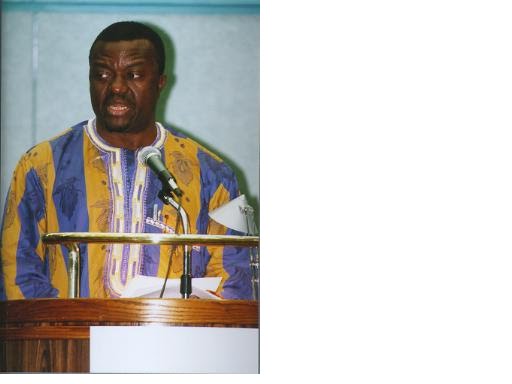
Njawe died July 12, 2010 in a car crash on Interstate 664. But the many lessons he taught, core among them being accommodating to diverse opinions, however heretical, could not be silenced by the screeching trailer that ended his life.
A pioneer who started one of the first privately owned newspapers in Africa, Le Messager, Njawe maintained uncompromising stance against censorship. Yet, he demanded that journalists must have a sense of curiosity, which should consequently generate a critical mind that only trusts what can be confirmed by independent examination. This was the spirit that midwifed Le Messeger. To Njawe, journalists are messengers: drum-beaters who must warn the villagers before a storm strikes, seismographers who warn the city dwellers of an imminent quake, surgeons whose residence is a social laboratory. He knew politicians take too long to come to our aid even when we are suffocating under an economic Katrina or a political Tsunami.
These lessons must remain our guide as we pursue the ideals Njawe fought and lived for, and we must not allow for mistakes. There will be challenges along the way. But as Njawe's tough constitution showed, these challenges are not insurmountable. Even when President Paul Biya's government loved to imprison him, Njawe's resolve could only be bolstered. In a smuggled prison note, Njawe once tearfully narrated how his pregnant wife suffered a miscarriage after she was beaten by prison wardens. His wife died in car crash in Cameroon in 2002. How high price, we must ask with John Milton, is it to pay for the great boon of freedom of discussion?
When I posted a message online to mourn his passing, I received a note from one of my mentors: "Car accident always seems so suspicious for someone like this. I hope it was just an accident - rather sad to immediately think those who feared him so much might go this far." How vicious can they be to follow him across the Atlantic, I thought. But we remain suspicious because the lily-livered oppressors who feared him so much, have never given us a reason to think otherwise.
But Njawe always focused on what his country deserved: a Cameroon that would allow truth to freely wrestle with falsehood, where truth would eventually triumph, just like the Miltonian marketplace of ideas.
I met and interacted with him during my tenure at the Mayborn Graduate Institute of Journalism in Denton, TX. He was brave and optimistic. His sonorous voice commanded attention. He was eloquent - in English and French. He was a wordsmith - on paper and in speech. He possessed a mature sense of humor.
In him I saw the embodiment of Africa's resilience that thrives in spite of government callousness and insensitivity.

We spoke of a brighter future in Cameroon and in Africa. Even with what he had gone through, not once did I hear him use a condemnatory tone toward his country. He acknowledged that politicians had plunged most African countries into an abyss. He knew the abyss is deep, but not unfathomable. He knew there was work to be done in Cameroon and in Africa. That is how we must honor him: Let us go to work - For le messeger can not die, will never die. Go well, Pius. Stay well, le messeger, and Rest in Peace.
Friday, March 05, 2010
Wednesday, March 03, 2010
Tuesday, March 02, 2010
Tuesday, February 23, 2010
Thursday, February 18, 2010
The United Nations Foundation latest report — New Technologies in Emergencies and Conflicts: The Role of Information and Social Networks — looks at innovation in the use of technology along the timeline of crisis response, from emergency preparedness and alerts to recovery and rebuilding.
Saturday, February 06, 2010
Thursday, September 17, 2009
CALL FOR CHAPTER PROPOSALS
Proposal Submission Deadline: October 30, 2009
Full Chapter Submission Deadline: February 28, 2010
Cultural Identity and New Communication Technologies:
Political, Ethnic and Ideological Implications
A book edited by Dr. D. Ndirangu Wachanga
University of Wisconsin-Whitewater, USA
To be published by IGI Global
Proposal Submission Deadline: October 30, 2009
Full Chapter Submission Deadline: February 28, 2010
Cultural Identity and New Communication Technologies:
Political, Ethnic and Ideological Implications
A book edited by Dr. D. Ndirangu Wachanga
University of Wisconsin-Whitewater, USA
To be published by IGI Global
Tuesday, September 15, 2009
Wednesday, August 19, 2009
Tuesday, June 16, 2009
Narratives of hate
When Claude Shannon (1948) developed his model of information, he was concerned with noise in telephone systems and how to reduce it or change the message structure to insure its reception. When Wilson (1960) asks how often human beings understand each other, he is acknowledging that human information systems include noise, too. This is not always evident. We may, therefore, benefit from examining the use of metaphors as a creative language activity that serves communication, cultural and socio-political purposes. Importantly, greater insight may be gained by examining an extreme situation: the use of metaphors to construct narratives of ethnic hatred during the 2007 pre- and post- election violence (PEV) in Kenya.
This paper seeks to illustrate how speakers sometimes use metaphors to mean what they don’t say as opposed to saying what they don’t mean through an examination of a number of metaphors used during the 2007 Kenyan crisis. The paper uses both information science and mass communication theoretical frameworks in interrogating this phenomenon.
A brief overview of the 2007 Kenyan electoral violence
When Kenya went to the polls in 2007, the country was ethnically divided more than ever before in its political history. Two political forces were competing for power: the Orange Democratic Party (ODM) and the Party of National Unity (PNU). ODM was a coalition of two major ethnic communities: Luo and Kalenjin. PNU was seen as being predominantly Kikuyu, the most populous ethnic community in Kenya. Other smaller communities aligned to one of these two parties. During the campaign period, both parties mobilized their ethnic supporters and demonized their opponents. The campaign was as ethnic as it was political. What followed was heightened propaganda that facilitated the construction of narratives of ethnic antagonism.
These narratives were predominantly constructed and disseminated through vernacular radio stations. It is worth noting that radio continues to be an unrivalled source of information in Africa and other developing parts of the world. This medium was extensively used during the campaign period. When the presidential results were announced in favor of PNU, Kenya degenerated into an unprecedented political turmoil. According to the Commission of Inquiry into Post-Election Violence (CIPEV, 2008), 1,133 people were killed and 350,000 internally displaced during the Kenyan post-election violence. The violence ended after three months of bloodshed when a group of Eminent Persons, led by the former UN Secretary General, Kofi Annan, brokered a shared power deal between the aggrieved parties. A prime minister position was proposed and entrenched in the Kenyan Constitution as part of the peace deal. The premier position, like that of the president, has executive powers invested in it. The position was strategically created to accommodate the ODM leader, Raila Odinga as one of the principals in the new Coalition Government.
Although the violence was triggered by the announcement of the contentious presidential election results, the bloodshed that visited Kenya has been defined as a political crisis with ethnic overtones. The media, especially the vernacular radio stations, were heavily blamed for constructing and fanning ethnic discourses that dangerously inflamed ethnic tension and passions. Carefully embellished metaphors were used as building blocks of narratives of hatred broadcast by various vernacular radio stations before and after the election. The result of these broadcasts, although not entirely responsible for, was a near-genocide.
Vernacular radio and ethnic loyalty
In Kenya, and in most other African countries, belonging to a certain ethnic community is equated with membership to a certain nationality; a kind of a small world. There exists a stronger allegiance to intra-ethnic identity within these small worlds than commitment to the ideals of the nation state. Language is a key ethnic marker in Kenya and it acts as a basic template for purveying sectarian and divisive ideas.
It is not surprising that civic duties often reflect allegiance to perceived ethnic ideals, as opposed to commitment to nation state’s ideals. This difference is prevalent in the political course of action associated with ethnic membership. Political loyalty, as a result, follows conspicuously ethnic lines. Consequently, political competition along ethnic lines harbors a huge potential of generating political animosity. During such power struggles, “individuals develop an intense hate and often use every means available to foment hate in their fellow citizens in order to gain the support they need to achieve their goals” (Sternberg & Sternberg, 2008, p. 6). The Somali experience has showed how differences among clans can be as detrimental as those among ethnic groups when it comes to power struggle.
This is reminiscent of the former Yugoslavia where the Serbs, being predominantly Orthodox, and Croats, being predominantly Catholic, considered themselves different as manifested in their political dispositions. Just like the religious differences between the Serbs and the Croats, ethnicity can also be perceived as membership in a small world that enables its members to adopt sanctioned viewpoints that define not only membership in a small world, but also non-membership of “ the others.” This idea of membership resonates with that of Wilson (1983, p. 3) on how we adopt perspective depending on the ethnic communities to which we belong, or depending upon our membership in certain small worlds: “We make points, take lines, occupy positions; we view, we see other’s point, but from our own angle.” Making points or taking views from “our own angle” can generate a conflict with that of “the other.” These conflicts manifest in several ways: political, religious, cultural, economic or social. Yet, whichever form the conflict assumes, information plays a vital role, both as a weapon and a target.
Gikandi (2008) provides an ingenious insight on the genesis of the Kenyan violence. According to him, the elites and intellectuals were the chief architects of narratives of hatred and ethnic hostility because they own the media and have the requisite power to control and influence the media content, just as they are able to shape the opinion of the masses. Gikandi argues that “ethnic identity is essentially a modern invention of ethnic elites and intellectuals pursuing economic and political objectives” (Karnell, 2003, p. 58). This view also acknowledges that the elites wield power and that they employ commonalities such as the media, language and religion as emotional building blocks in ethnic and political mobilization.
Gikandi’s constructivist perspective considers ethnicity as primarily built and manipulated in emotionally-laden symbolic and communicative spaces. Vital in this space is construction of messages only intelligible to certain audiences. Metaphors play a significant role in this space as well as in the construction of intention-driven, persuasive and strategic messages.
This was apparent in Kenya during the PEV in which vernacular radio stations spewed vitriol against perceived – real or imagined – politico-ethnic enemies. The language used was metaphorically-couched, so creative that one required ethnic knowledge to decipher. This strategic metaphorical construction of “reality,” in order to reach a certain audience while simultaneously disenfranchising the perceived enemies, has been used to antagonize communities in multilingual societies, not just in Kenya.
A case in point is the 1994 Rwandese genocide during which hate radio was used to construct and disseminate metaphors that incited the Hutus against the Tutsis. Before the genocide, Tutsis were metaphorically referred to as inyenzi, or cockroaches in almost every radio broadcast that aired. The metaphor inyenzi had been used by the Tutsi exiles that fled Rwanda following the revolution of 1959 after the toppling of the Tutsi monarchical fabric. The metaphorical reference of the Tutsis as inyenzi implied that, with time, they would, with the tenacity of the household pests, stealthily invade at night. However, this metaphor was co-opted by the Hutus and redefined in the early 1990s. The term Inyenzi went through a metamorphosis and was used in reference to rancorous vermin worthy of extermination from the Rwandese household (See also “Trial of Rwanda ‘hate radio’ organizers adjourned” September 18, 2005, www.cnn.com). But since these metaphors are not merely self-referring entities with a potential to drive self identified linguistic or ethnic group toward the unexpected, one must accentuate the historical burden these metaphors carry. These metaphors, as used in the Rwandese and the Kenyan cases, were often imbued with historical resonances that serve as an expose to not only the intersecting elements of ethnicity, class, and gender, but also to their (metaphors) very construction as a result of these elements.
In order to gain an in-depth meaning of the metaphors used during the Kenyan crisis, discourse analysis and critical discourse analysis were used as key approaches in this study. Discourse analysis considers discourse as data (Potter, 1997). As an approach, it is epistemologically constructivist in orientation. Yet to construct metaphorically, refers to making careful and even strategic considerations of existing linguistic components to build a discourse, to construct a narrative. Discourse analysis is an examination of human interactions and resultant acts. The focus of this paper is on the functional orientation of metaphors as a form of discourse that is constructed to generate a response, the action-effect of utterances – in this case hatred.
Discourse analysis helps in our examination of the interactions among members of different ethnic communities and their use of language in the production, consumption and interpretation of metaphors. Critical Discourse Analysis (CDA) serves us well in the interrogation of the relationship between language and society. Blommaert (2005) has observed how CDA involves the intersections and interrelationships among language, discourse, speech and social interactions. Yet, discourse can be textual, discursive and a social practice. Fairclough (1992) has delineated three categories of discourse analysis. According to Fairclough, analyzing discourse-as-text focuses on linguistic components such as grammar, words and sentence structure, while discourse-as-discursive practice is a document (textual or spoken) that is packaged, disseminated and consumed in the society.
To avoid confusion with other notions of information, which fail to recognize that one can receive information without being informed, we apply a specific definitional model by noting the difference between the message and meaning of various metaphors. We examine metaphors by critiquing Paisley’s (1980) definition of information as any stimulus that changes the information recipient’s cognitive structure (see also, Hayes, 1991). Our focus pays particular attention to the propagators of metaphors and the intended recipients. In the process of propagating metaphors we differentiate among facts, data, metaphors, communication, and understanding.
Metaphors, in our case, involve data processing, a process that is external to the metaphor recipient. Once the metaphor is communicated, the recipient may derive the meaning from the message, but in a way not always intended by the source. Can a recipient claim to understand a message and yet appear to have misunderstood it in the eyes of the source? Hayes (1993) has addressed this complexity by defining terms such as understanding and knowledge. But acquisition of understanding and knowledge may require membership in a certain small world. What circumcision means, for instance, in certain communities may mean something different in other communities. To some, it is a medical necessity, a physical surgery, while for others it is a rite of passage with huge cultural implications upon which ontological systems are built.
This process of metaphor propagation is dependent on various factors such as context and the cognitive ability to decode them. Underlying the process of metaphor propagation is a set of dominant ethnic taken-for-granted ideas and assumptions, what Antonio Gramsci called hegemony. Hegemony, which is the dominant ideological framework embodied, inscribed and often perceptively invisible via a multitude of symbolic practices of storytelling, artistic displays, rites of passage and many other acts, serves to construct the small world of the particular ethnic community while it excludes “the others” who do not belong to the small world. As McQuail (2000, p. 97) notes, “hegemony tends to define unacceptable opposition to the status quo as dissident and deviant.” Thus, through symbolic practices, all those who have been excluded from the preferred and dominant small world must be marginalized, excluded and often demonized for the small world to maintain its hegemonic integrity. Metaphors, therefore, become important components of the socially-constructed symbolic practices that mobilize preferred interpretations of belonging, not belonging as well as framing “the other” as deviant, unacceptable and worthy of exclusion or even extermination.
Metaphors
Scholars such as Todoli (2007) have warned against an uncritical acceptance of metaphors, especially because some metaphors may have multiple meanings even within the same speech community. Metaphors acquire a life of their own, depending upon how they are used to propagate a discourse. Once constructed, they can tumble “anywhere among those who may or may not understand them, and know not to whom they should reply, to whom not” (Phaedrus, 275).
Faced with possibilities of (mis)interpretation, why then, one may ask, should we use metaphors? Metaphors vividly express what would otherwise be “difficult to express in literal speech” (Mio 1997, p.121). They also add vivacity to speech and allow acceptable breaking of language rules in order to communicate certain ideas (See also Gibbs, 1994). In fact, Charteris-Black (2004) sees metaphors as an embodiment of verbalized evidence. Although Todoli (2007) acknowledges the potential of metaphors in myth deconstruction, they also possess huge potential in myth construction, especially when the intention is to disenfranchise particular audiences from a discourse.
Conclusion
Most metaphors used during the Kenyan PEV existed before and had been accepted even as a rich source of ethnic stereotypical humor. They did not have any atavistic undertones they acquired during the electoral period. The context of deployment frames the meaning and potency of use. There are several Kenyan comedians who have thrived on these ethnic metaphors. We, therefore note that the potency of a metaphor is not in itself, but in the meaning we imbue it with, which meaning is as fluid and transient as context changes.
This not only challenges the notion of metaphors with determinate meaning, but also problematizes their instrumentalization by the media, in our case vernacular radio stations. They serve as a rallying cry and a call to arms not because of the totality of what can be inferred from them - both positive and negative, but their signification of aspects of difference. It is this difference, which was exploited during the PEV not because of the metaphors but in spite of them. In other words the metaphors become substitutes for some other things, for example land and education. Metaphors became an effective vehicle to foreground differences even as they silenced the real raison de etre for the violence.
(A complete version of this paper is available on request)
When Claude Shannon (1948) developed his model of information, he was concerned with noise in telephone systems and how to reduce it or change the message structure to insure its reception. When Wilson (1960) asks how often human beings understand each other, he is acknowledging that human information systems include noise, too. This is not always evident. We may, therefore, benefit from examining the use of metaphors as a creative language activity that serves communication, cultural and socio-political purposes. Importantly, greater insight may be gained by examining an extreme situation: the use of metaphors to construct narratives of ethnic hatred during the 2007 pre- and post- election violence (PEV) in Kenya.
This paper seeks to illustrate how speakers sometimes use metaphors to mean what they don’t say as opposed to saying what they don’t mean through an examination of a number of metaphors used during the 2007 Kenyan crisis. The paper uses both information science and mass communication theoretical frameworks in interrogating this phenomenon.
A brief overview of the 2007 Kenyan electoral violence
When Kenya went to the polls in 2007, the country was ethnically divided more than ever before in its political history. Two political forces were competing for power: the Orange Democratic Party (ODM) and the Party of National Unity (PNU). ODM was a coalition of two major ethnic communities: Luo and Kalenjin. PNU was seen as being predominantly Kikuyu, the most populous ethnic community in Kenya. Other smaller communities aligned to one of these two parties. During the campaign period, both parties mobilized their ethnic supporters and demonized their opponents. The campaign was as ethnic as it was political. What followed was heightened propaganda that facilitated the construction of narratives of ethnic antagonism.
These narratives were predominantly constructed and disseminated through vernacular radio stations. It is worth noting that radio continues to be an unrivalled source of information in Africa and other developing parts of the world. This medium was extensively used during the campaign period. When the presidential results were announced in favor of PNU, Kenya degenerated into an unprecedented political turmoil. According to the Commission of Inquiry into Post-Election Violence (CIPEV, 2008), 1,133 people were killed and 350,000 internally displaced during the Kenyan post-election violence. The violence ended after three months of bloodshed when a group of Eminent Persons, led by the former UN Secretary General, Kofi Annan, brokered a shared power deal between the aggrieved parties. A prime minister position was proposed and entrenched in the Kenyan Constitution as part of the peace deal. The premier position, like that of the president, has executive powers invested in it. The position was strategically created to accommodate the ODM leader, Raila Odinga as one of the principals in the new Coalition Government.
Although the violence was triggered by the announcement of the contentious presidential election results, the bloodshed that visited Kenya has been defined as a political crisis with ethnic overtones. The media, especially the vernacular radio stations, were heavily blamed for constructing and fanning ethnic discourses that dangerously inflamed ethnic tension and passions. Carefully embellished metaphors were used as building blocks of narratives of hatred broadcast by various vernacular radio stations before and after the election. The result of these broadcasts, although not entirely responsible for, was a near-genocide.
Vernacular radio and ethnic loyalty
In Kenya, and in most other African countries, belonging to a certain ethnic community is equated with membership to a certain nationality; a kind of a small world. There exists a stronger allegiance to intra-ethnic identity within these small worlds than commitment to the ideals of the nation state. Language is a key ethnic marker in Kenya and it acts as a basic template for purveying sectarian and divisive ideas.
It is not surprising that civic duties often reflect allegiance to perceived ethnic ideals, as opposed to commitment to nation state’s ideals. This difference is prevalent in the political course of action associated with ethnic membership. Political loyalty, as a result, follows conspicuously ethnic lines. Consequently, political competition along ethnic lines harbors a huge potential of generating political animosity. During such power struggles, “individuals develop an intense hate and often use every means available to foment hate in their fellow citizens in order to gain the support they need to achieve their goals” (Sternberg & Sternberg, 2008, p. 6). The Somali experience has showed how differences among clans can be as detrimental as those among ethnic groups when it comes to power struggle.
This is reminiscent of the former Yugoslavia where the Serbs, being predominantly Orthodox, and Croats, being predominantly Catholic, considered themselves different as manifested in their political dispositions. Just like the religious differences between the Serbs and the Croats, ethnicity can also be perceived as membership in a small world that enables its members to adopt sanctioned viewpoints that define not only membership in a small world, but also non-membership of “ the others.” This idea of membership resonates with that of Wilson (1983, p. 3) on how we adopt perspective depending on the ethnic communities to which we belong, or depending upon our membership in certain small worlds: “We make points, take lines, occupy positions; we view, we see other’s point, but from our own angle.” Making points or taking views from “our own angle” can generate a conflict with that of “the other.” These conflicts manifest in several ways: political, religious, cultural, economic or social. Yet, whichever form the conflict assumes, information plays a vital role, both as a weapon and a target.
Gikandi (2008) provides an ingenious insight on the genesis of the Kenyan violence. According to him, the elites and intellectuals were the chief architects of narratives of hatred and ethnic hostility because they own the media and have the requisite power to control and influence the media content, just as they are able to shape the opinion of the masses. Gikandi argues that “ethnic identity is essentially a modern invention of ethnic elites and intellectuals pursuing economic and political objectives” (Karnell, 2003, p. 58). This view also acknowledges that the elites wield power and that they employ commonalities such as the media, language and religion as emotional building blocks in ethnic and political mobilization.
Gikandi’s constructivist perspective considers ethnicity as primarily built and manipulated in emotionally-laden symbolic and communicative spaces. Vital in this space is construction of messages only intelligible to certain audiences. Metaphors play a significant role in this space as well as in the construction of intention-driven, persuasive and strategic messages.
This was apparent in Kenya during the PEV in which vernacular radio stations spewed vitriol against perceived – real or imagined – politico-ethnic enemies. The language used was metaphorically-couched, so creative that one required ethnic knowledge to decipher. This strategic metaphorical construction of “reality,” in order to reach a certain audience while simultaneously disenfranchising the perceived enemies, has been used to antagonize communities in multilingual societies, not just in Kenya.
A case in point is the 1994 Rwandese genocide during which hate radio was used to construct and disseminate metaphors that incited the Hutus against the Tutsis. Before the genocide, Tutsis were metaphorically referred to as inyenzi, or cockroaches in almost every radio broadcast that aired. The metaphor inyenzi had been used by the Tutsi exiles that fled Rwanda following the revolution of 1959 after the toppling of the Tutsi monarchical fabric. The metaphorical reference of the Tutsis as inyenzi implied that, with time, they would, with the tenacity of the household pests, stealthily invade at night. However, this metaphor was co-opted by the Hutus and redefined in the early 1990s. The term Inyenzi went through a metamorphosis and was used in reference to rancorous vermin worthy of extermination from the Rwandese household (See also “Trial of Rwanda ‘hate radio’ organizers adjourned” September 18, 2005, www.cnn.com). But since these metaphors are not merely self-referring entities with a potential to drive self identified linguistic or ethnic group toward the unexpected, one must accentuate the historical burden these metaphors carry. These metaphors, as used in the Rwandese and the Kenyan cases, were often imbued with historical resonances that serve as an expose to not only the intersecting elements of ethnicity, class, and gender, but also to their (metaphors) very construction as a result of these elements.
In order to gain an in-depth meaning of the metaphors used during the Kenyan crisis, discourse analysis and critical discourse analysis were used as key approaches in this study. Discourse analysis considers discourse as data (Potter, 1997). As an approach, it is epistemologically constructivist in orientation. Yet to construct metaphorically, refers to making careful and even strategic considerations of existing linguistic components to build a discourse, to construct a narrative. Discourse analysis is an examination of human interactions and resultant acts. The focus of this paper is on the functional orientation of metaphors as a form of discourse that is constructed to generate a response, the action-effect of utterances – in this case hatred.
Discourse analysis helps in our examination of the interactions among members of different ethnic communities and their use of language in the production, consumption and interpretation of metaphors. Critical Discourse Analysis (CDA) serves us well in the interrogation of the relationship between language and society. Blommaert (2005) has observed how CDA involves the intersections and interrelationships among language, discourse, speech and social interactions. Yet, discourse can be textual, discursive and a social practice. Fairclough (1992) has delineated three categories of discourse analysis. According to Fairclough, analyzing discourse-as-text focuses on linguistic components such as grammar, words and sentence structure, while discourse-as-discursive practice is a document (textual or spoken) that is packaged, disseminated and consumed in the society.
To avoid confusion with other notions of information, which fail to recognize that one can receive information without being informed, we apply a specific definitional model by noting the difference between the message and meaning of various metaphors. We examine metaphors by critiquing Paisley’s (1980) definition of information as any stimulus that changes the information recipient’s cognitive structure (see also, Hayes, 1991). Our focus pays particular attention to the propagators of metaphors and the intended recipients. In the process of propagating metaphors we differentiate among facts, data, metaphors, communication, and understanding.
Metaphors, in our case, involve data processing, a process that is external to the metaphor recipient. Once the metaphor is communicated, the recipient may derive the meaning from the message, but in a way not always intended by the source. Can a recipient claim to understand a message and yet appear to have misunderstood it in the eyes of the source? Hayes (1993) has addressed this complexity by defining terms such as understanding and knowledge. But acquisition of understanding and knowledge may require membership in a certain small world. What circumcision means, for instance, in certain communities may mean something different in other communities. To some, it is a medical necessity, a physical surgery, while for others it is a rite of passage with huge cultural implications upon which ontological systems are built.
This process of metaphor propagation is dependent on various factors such as context and the cognitive ability to decode them. Underlying the process of metaphor propagation is a set of dominant ethnic taken-for-granted ideas and assumptions, what Antonio Gramsci called hegemony. Hegemony, which is the dominant ideological framework embodied, inscribed and often perceptively invisible via a multitude of symbolic practices of storytelling, artistic displays, rites of passage and many other acts, serves to construct the small world of the particular ethnic community while it excludes “the others” who do not belong to the small world. As McQuail (2000, p. 97) notes, “hegemony tends to define unacceptable opposition to the status quo as dissident and deviant.” Thus, through symbolic practices, all those who have been excluded from the preferred and dominant small world must be marginalized, excluded and often demonized for the small world to maintain its hegemonic integrity. Metaphors, therefore, become important components of the socially-constructed symbolic practices that mobilize preferred interpretations of belonging, not belonging as well as framing “the other” as deviant, unacceptable and worthy of exclusion or even extermination.
Metaphors
Scholars such as Todoli (2007) have warned against an uncritical acceptance of metaphors, especially because some metaphors may have multiple meanings even within the same speech community. Metaphors acquire a life of their own, depending upon how they are used to propagate a discourse. Once constructed, they can tumble “anywhere among those who may or may not understand them, and know not to whom they should reply, to whom not” (Phaedrus, 275).
Faced with possibilities of (mis)interpretation, why then, one may ask, should we use metaphors? Metaphors vividly express what would otherwise be “difficult to express in literal speech” (Mio 1997, p.121). They also add vivacity to speech and allow acceptable breaking of language rules in order to communicate certain ideas (See also Gibbs, 1994). In fact, Charteris-Black (2004) sees metaphors as an embodiment of verbalized evidence. Although Todoli (2007) acknowledges the potential of metaphors in myth deconstruction, they also possess huge potential in myth construction, especially when the intention is to disenfranchise particular audiences from a discourse.
Conclusion
Most metaphors used during the Kenyan PEV existed before and had been accepted even as a rich source of ethnic stereotypical humor. They did not have any atavistic undertones they acquired during the electoral period. The context of deployment frames the meaning and potency of use. There are several Kenyan comedians who have thrived on these ethnic metaphors. We, therefore note that the potency of a metaphor is not in itself, but in the meaning we imbue it with, which meaning is as fluid and transient as context changes.
This not only challenges the notion of metaphors with determinate meaning, but also problematizes their instrumentalization by the media, in our case vernacular radio stations. They serve as a rallying cry and a call to arms not because of the totality of what can be inferred from them - both positive and negative, but their signification of aspects of difference. It is this difference, which was exploited during the PEV not because of the metaphors but in spite of them. In other words the metaphors become substitutes for some other things, for example land and education. Metaphors became an effective vehicle to foreground differences even as they silenced the real raison de etre for the violence.
(A complete version of this paper is available on request)
Monday, May 04, 2009
Tuesday, September 09, 2008
Icons of peace who walked on our earth ---Dr. Wachanga
Before Mahatma Gandhi, that icon who declared that only truth conquers, succumbed to three bullets from an assassin on 30th January 1948, one of the greatest thinkers, Albert Einstein had already immortalized the reverence, which Gandhi would later demand from humanity: Generations to come will scarce believe that such a one as this ever in flesh and blood walked upon this earth. The same month, almost 20 years before, Martin Luther King Jr., who was to profoundly derive inspiration from Gandhi, was born in Atlanta, Georgia. Both, at different times, took upon themselves to enlighten a society that had become what psychoanalysts would call a bad mother, a cannibal that devours her own offspring.
Born Mohandas Karamchand in October 1869, Gandhi led India to independence from a restrictive British colonial system. A simple man, owning only two pairs of leather sandals and spectacles, Gandhi pursued Satyagraha, truth force; a system of non-violence formulated on understanding that India’s civilization demanded a “different and higher weapon for self-protection.” His philosophy, rooted in a firm belief that human beings have a deep need to love and to be loved, as opposed to hate and to be hated, changed many hearts of the world, carving a lasting niche as a “solace to innumerable souls.” He constantly reminded the world that the good in humanity should arouse love, not hate, that human energy should only be used for what is good, that truth has power; it eventually conquers, a fact he exemplified when he defied the Salt Laws that oppressed his people. He led numerous demonstrations, impressing on his followers not to hate the colonialists, but their ideas; to reject the colonialists' acts and not to hurt them.
A veritable embodiment of love, Gandhi inspired Martin Luther King Jr. as he fought for racial equality in the United States. Like Gandhi, King knew that one who lacks something to die for is not fit to live. Like Gandhi, he resisted the temptation of violent confrontation, even when criticism abound from militant activists like Stokely Carmichaels, the young philosophy graduate who first shouted “black power!” along the highway in Mississippi in 1966.
When Malcolm X saw King’s “dream” as swiftly degenerating into a nightmare, urging African-Americans to either use the ballot or the bullet in 1964, King maintained the need to “ rise to the majestic heights of meeting physical force with soul force,” of not allowing “ creative protests to degenerate into physical violence.”
Paradoxically, both men, who never held a weapon during their protests, whose lips only knew the word peace, whose lives exceptionally personified the significance of human dignity, met their death through assassins.
While we wonder what would be their advice in a world so insecure, sections of our society marginalized, poverty stricken, AIDS ravaged, environmentally degraded, humanity threatened, culturally castrated, virtues despised; one thing is certain: we can only ignore them and their legacy at our own peril, for these two belonged to the world.
Before Mahatma Gandhi, that icon who declared that only truth conquers, succumbed to three bullets from an assassin on 30th January 1948, one of the greatest thinkers, Albert Einstein had already immortalized the reverence, which Gandhi would later demand from humanity: Generations to come will scarce believe that such a one as this ever in flesh and blood walked upon this earth. The same month, almost 20 years before, Martin Luther King Jr., who was to profoundly derive inspiration from Gandhi, was born in Atlanta, Georgia. Both, at different times, took upon themselves to enlighten a society that had become what psychoanalysts would call a bad mother, a cannibal that devours her own offspring.
Born Mohandas Karamchand in October 1869, Gandhi led India to independence from a restrictive British colonial system. A simple man, owning only two pairs of leather sandals and spectacles, Gandhi pursued Satyagraha, truth force; a system of non-violence formulated on understanding that India’s civilization demanded a “different and higher weapon for self-protection.” His philosophy, rooted in a firm belief that human beings have a deep need to love and to be loved, as opposed to hate and to be hated, changed many hearts of the world, carving a lasting niche as a “solace to innumerable souls.” He constantly reminded the world that the good in humanity should arouse love, not hate, that human energy should only be used for what is good, that truth has power; it eventually conquers, a fact he exemplified when he defied the Salt Laws that oppressed his people. He led numerous demonstrations, impressing on his followers not to hate the colonialists, but their ideas; to reject the colonialists' acts and not to hurt them.
A veritable embodiment of love, Gandhi inspired Martin Luther King Jr. as he fought for racial equality in the United States. Like Gandhi, King knew that one who lacks something to die for is not fit to live. Like Gandhi, he resisted the temptation of violent confrontation, even when criticism abound from militant activists like Stokely Carmichaels, the young philosophy graduate who first shouted “black power!” along the highway in Mississippi in 1966.
When Malcolm X saw King’s “dream” as swiftly degenerating into a nightmare, urging African-Americans to either use the ballot or the bullet in 1964, King maintained the need to “ rise to the majestic heights of meeting physical force with soul force,” of not allowing “ creative protests to degenerate into physical violence.”
Paradoxically, both men, who never held a weapon during their protests, whose lips only knew the word peace, whose lives exceptionally personified the significance of human dignity, met their death through assassins.
While we wonder what would be their advice in a world so insecure, sections of our society marginalized, poverty stricken, AIDS ravaged, environmentally degraded, humanity threatened, culturally castrated, virtues despised; one thing is certain: we can only ignore them and their legacy at our own peril, for these two belonged to the world.
Africa can't wish away the Berlin Experience
Dr. Mzee Wachanga
The year 1884 remains tragic for Africa. It marks a catastrophic beginning when Africa unwillingly set off on a journey of wretchedness. The continent’s destiny was tragically dictated in a meeting held in Berlin. Representatives from 14 countries attended the conference with Great Britain, France, Germany, and Portugal being the chief players. After three months of intense haggling over geometric partitioning of the continent, unholy pact, Berlin Act of 1885, was signed, allocating “spheres of influence” to represented countries. Partitioning was hurriedly done with sickening disregard to existing socio-political and econo-cultural establishments, which were indigenous in nature. Linguistic differences, intellectual endowments, and ethnic set-up of different communities were overlooked in this overpowering and mind-boggling process. Ethnic people with contrasting backgrounds ended up discordantly lumped together in restrictive colonies. Ethnic antagonism was consequently inevitable. The Biafran war in Nigeria is a regrettable example of ethnic intolerance between communities with disparate backgrounds.
More disturbing is the campaign that ensured, with the colonialists desperately putting measures in place intended to empty the Africans mind of its intellect. Africans identity was devastatingly, almost irredeemably distorted. By 1914, the continent was suffocating under the weight of the predatory colonialists.
Africans beliefs became superstitions; their religion became idolatry, their culture became barbaric, and their way of life became atavistic and primitive in the eyes of the colonialists. With colonialism proceeding from religious sentiments, the continent got a baptism name: Dark. Even with a baptism name, it was seen, albeit erroneously, as devoid of history, its only worth story being the existence of the colonialist, the rest being darkness, which is “not a subject of history.” It became a terra incognita to geographers, land of savages to anthropologists, home of the primitives in the eyes of ethnologists. Africans’ mind, it was contemptuously remarked was a blank slate yearning for Western civilization. Could Wole Soyinka had this in mind when he quipped that the Black race knows, and is content simply to know, itself? That it is the European world that has sought, with utmost zeal, to re-define itself through its encounter with Africa?
It is with a reason that David Livingston, one of the earliest explorers summed up the four European interests in Africa: Christianity, civilization, commerce and conquest. A story is told of how colonialists, hypocritically with the Holy Writ on one hand, pretending to be the harbingers of the Holy word, tricked African into closing their eyes in prayers. When Africans opened their eyes, their land had been taken away. Worse still, the Bible was not on sight anymore. Instead, there was a whip ready to be cracked and a gun, with a finger ready on the trigger, constantly pulled, at times just for fun.
Critically appraising the arduous journey the African continent has gone through, one is confronted by a harsh realization of the correlation between its more than century old history and its current predicaments. As Africa continues to wrestle with a seemingly impenetrable, though not a totally subjugating unholy trinity of illiteracy, poverty and diseases, its debilitating colonial past significantly acts as the prism through which its reality must be perceived.
Dr. Mzee Wachanga
The year 1884 remains tragic for Africa. It marks a catastrophic beginning when Africa unwillingly set off on a journey of wretchedness. The continent’s destiny was tragically dictated in a meeting held in Berlin. Representatives from 14 countries attended the conference with Great Britain, France, Germany, and Portugal being the chief players. After three months of intense haggling over geometric partitioning of the continent, unholy pact, Berlin Act of 1885, was signed, allocating “spheres of influence” to represented countries. Partitioning was hurriedly done with sickening disregard to existing socio-political and econo-cultural establishments, which were indigenous in nature. Linguistic differences, intellectual endowments, and ethnic set-up of different communities were overlooked in this overpowering and mind-boggling process. Ethnic people with contrasting backgrounds ended up discordantly lumped together in restrictive colonies. Ethnic antagonism was consequently inevitable. The Biafran war in Nigeria is a regrettable example of ethnic intolerance between communities with disparate backgrounds.
More disturbing is the campaign that ensured, with the colonialists desperately putting measures in place intended to empty the Africans mind of its intellect. Africans identity was devastatingly, almost irredeemably distorted. By 1914, the continent was suffocating under the weight of the predatory colonialists.
Africans beliefs became superstitions; their religion became idolatry, their culture became barbaric, and their way of life became atavistic and primitive in the eyes of the colonialists. With colonialism proceeding from religious sentiments, the continent got a baptism name: Dark. Even with a baptism name, it was seen, albeit erroneously, as devoid of history, its only worth story being the existence of the colonialist, the rest being darkness, which is “not a subject of history.” It became a terra incognita to geographers, land of savages to anthropologists, home of the primitives in the eyes of ethnologists. Africans’ mind, it was contemptuously remarked was a blank slate yearning for Western civilization. Could Wole Soyinka had this in mind when he quipped that the Black race knows, and is content simply to know, itself? That it is the European world that has sought, with utmost zeal, to re-define itself through its encounter with Africa?
It is with a reason that David Livingston, one of the earliest explorers summed up the four European interests in Africa: Christianity, civilization, commerce and conquest. A story is told of how colonialists, hypocritically with the Holy Writ on one hand, pretending to be the harbingers of the Holy word, tricked African into closing their eyes in prayers. When Africans opened their eyes, their land had been taken away. Worse still, the Bible was not on sight anymore. Instead, there was a whip ready to be cracked and a gun, with a finger ready on the trigger, constantly pulled, at times just for fun.
Critically appraising the arduous journey the African continent has gone through, one is confronted by a harsh realization of the correlation between its more than century old history and its current predicaments. As Africa continues to wrestle with a seemingly impenetrable, though not a totally subjugating unholy trinity of illiteracy, poverty and diseases, its debilitating colonial past significantly acts as the prism through which its reality must be perceived.
Subscribe to:
Posts (Atom)